

 Home
HomeMove funds programmatically across deposit, omnibus, and cold wallets with sub-100ms signing and policy-enforced access control at every transaction. For a basic signing walkthrough, start with the Quickstart. This guide covers the key implementation decisions for company wallet payment flows, then walks through a production example end-to-end: creating per-user deposit addresses, sweeping those deposits into an omnibus wallet with gas sponsorship, and gating treasury outflows with multi-party approval.Documentation Index
Fetch the complete documentation index at: https://turnkey-0e7c1f5b-graham-docs-revamp.mintlify.app/llms.txt
Use this file to discover all available pages before exploring further.
Powered by Turnkey
Leading platforms use Turnkey to deliver onchain payment rails at scale:- Squads improved UX and accounting efficiency for multisig treasury management.
- Flutterwave powers secure stablecoin wallets for customers across Africa.
Key implementation decisions
| Decision | What to consider |
|---|---|
| Wallet architecture | Single HD wallet with many accounts (cost-efficient, shared seed) vs separate wallets per function (deposits, omnibus, cold) |
| Deposit addressing | Per-user deposit addresses via createWalletAccounts at no extra cost |
| Sweep strategy | Policy-enforced sweeps restricting deposit addresses to a single omnibus destination |
| Gas management | Sponsored transactions (sponsor: true) eliminate the need to fund each deposit address for gas |
| Chain coverage | EVM and SVM require separate policies due to different transaction models |
| Hot wallet controls | Automated API key user with policies scoping exactly which transfers are allowed |
| Treasury controls | Multi-party approval via consensus expressions (e.g., 2-of-N ops team) |
| Cold storage transfers | Policy-gated with parsed calldata for token transfers, or upload the contract ABI for full parsing |
Example: custodial payment processing
Exchanges and custodial payment processors are common examples requiring highly scalable, highly secure onchain systems.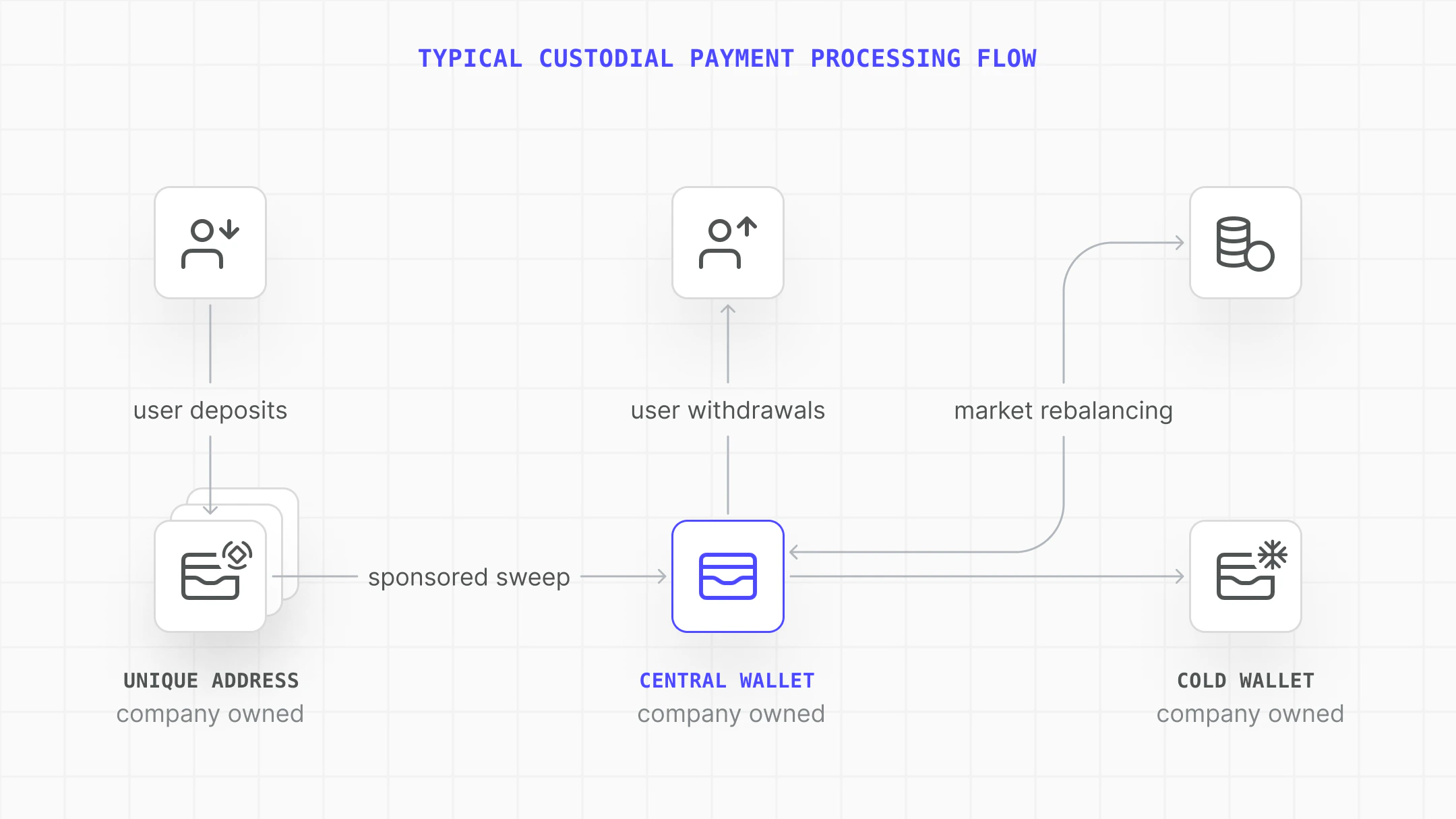
| Need | How Turnkey solves it |
|---|---|
| All users have a unique deposit address | Wallet accounts are efficiently created and controlled within a Turnkey organization |
| Access to all wallets must be strictly permissioned | Policies enforce RBAC and least-privilege for all signing actions |
| Keys must never be exposed | Keys remain in the secure enclave; only signatures are returned |
| Must support automation and human review | Policies allow automation for routine tasks and require multi-party consensus for sensitive ones |
| Must move funds efficiently | Transaction sponsorship eliminates the cost of funding thousands of deposit addresses for gas |
Implementation steps
This guide assumes you’ve completed the Quickstart and have a Turnkey client initialized. If not, start there first.
Create deposit addresses on demand
Turnkey lets you create unlimited wallet accounts at no cost, each with a unique address belonging to the same underlying wallet. Create a deposits wallet with both EVM and SVM accounts:Then generate fresh deposit addresses on demand:This function can be triggered by end-user signup, a deposit request, or any internal flow.
Sweep deposits to an omnibus wallet
Now that you have deposit addresses generating on demand, the next step is moving those funds into a central omnibus wallet. This is where the complexity typically starts: sweeping funds from thousands of addresses involves both security and cost considerations.Policy-enforced sweepsCreate policies that restrict deposit wallets to only transfer to the omnibus address. EVM and SVM require separate policies due to their different transaction models:Turnkey’s Policy Engine is default-deny: you only specify the exact conditions to allow. Raw or obfuscated payloads are rejected unless explicitly permitted.Gas sponsorshipNormally you’d need to fund every deposit address with gas before sweeping. Sponsored transactions bypass this entirely:See the gas sponsorship guide for more details.
Treasury flows with multi-party approval
The omnibus wallet likely requires human-operator approval for outbound transfers and may need more sophisticated automations like asset rebalancing.Create a user tag (e.g., For token transfers, the policy above parses the ERC-20
ops-team) and apply it to your teammates, then set a policy requiring their approval for transfers to a cold wallet:transfer function signature. For production use, the recommended approach is to upload the contract ABI for supported assets and act on fully parsed transactions.